
Roofing Contractor in Sterling, VA
Sterling has two very different housing eras under one name, and they need different roofs. We work in both.
Roofing for Sterling, Virginia
Sterling covers a wider span of construction history than any other community in eastern Loudoun County. Drive through Sterling Park and you are looking at ranchers and split-levels from the 1960s and early 1970s. Drive fifteen minutes west into the Cascades or Lowes Island and you are looking at 1990s colonials. Those two halves of Sterling have almost nothing in common once you get under the shingles.
That matters because the diagnosis is different. On an older Sterling Park house the question is usually what condition the roof deck is in and how many layers are up there. On a Cascades house it is usually whether the original 1990s shingle has reached the end of its run and whether the flashing details were done properly the first time.
What follows is the Sterling-specific side of a roofing project: how Loudoun County handles the permit, what changes when your neighborhood has no homeowners association at all, the decking surprises that come with 1960s construction, and the wind exposure this part of the county gets.
Permitting Roof Work in Sterling
Jurisdiction: Loudoun County Department of Building and Development
Sterling is an unincorporated community, so there is no separate town permit office. Every roof permit here goes through the Loudoun County Department of Building and Development under the Virginia Uniform Statewide Building Code, the same office that handles Ashburn and Leesburg's surrounding county areas. We pull the permit against our license rather than leaving it to the homeowner.
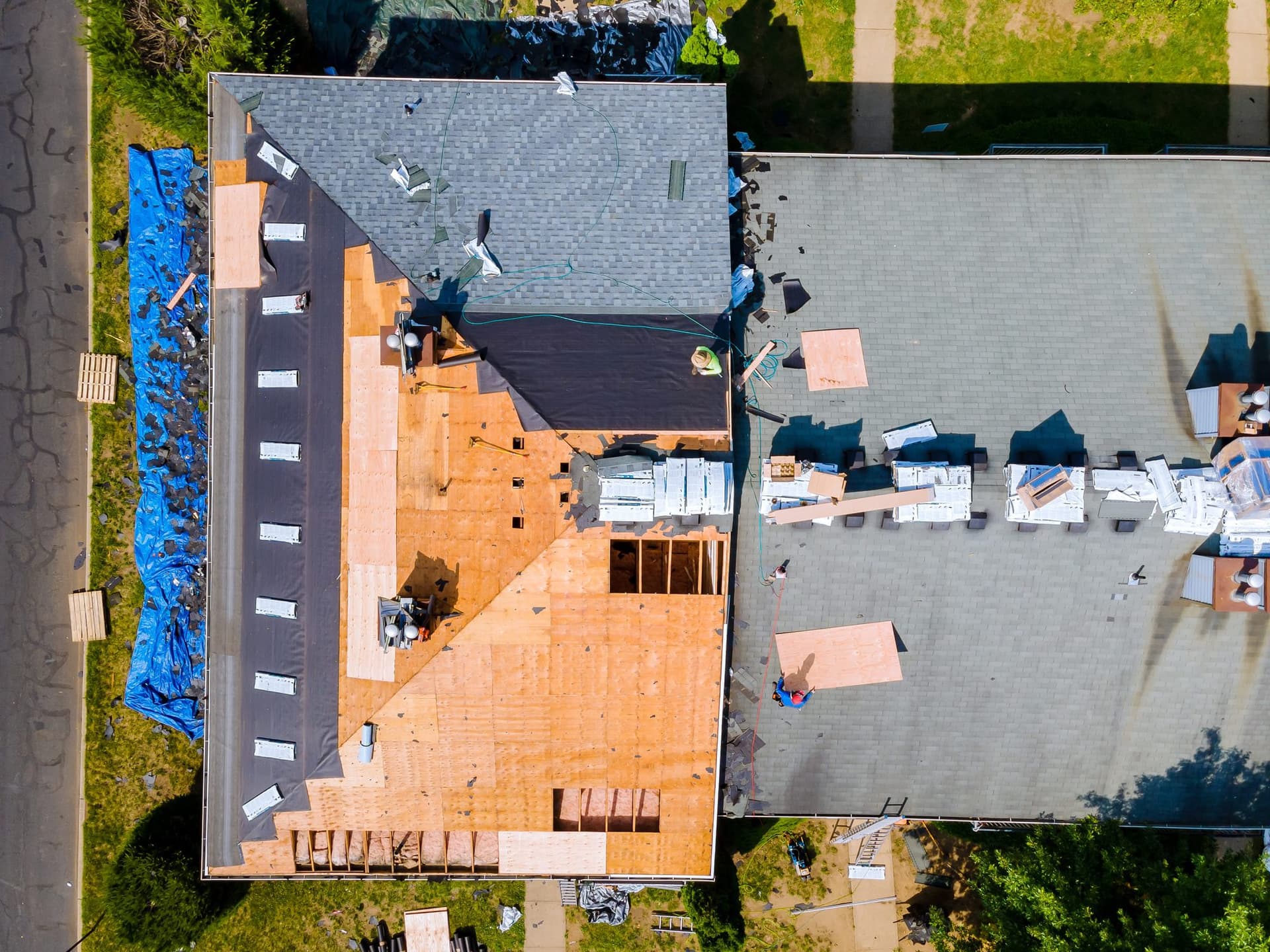
Where Sterling differs from newer parts of the county is what the inspector finds. On homes built in the 1960s and early 1970s, the roof deck is frequently board sheathing — individual planks with gaps between them — rather than the continuous plywood or OSB that came later. Gapped plank decking will not reliably hold modern shingle fasteners, and the code requires a substrate that will. Sometimes that means re-nailing and adding a layer of sheathing over the planks. That is a real cost, and it needs to be in the quote before work starts, not discovered on day two.
The second Sterling-specific finding is layer count. Houses that have been standing for fifty-plus years have often been re-roofed more than once, and where two applications of covering already exist the code does not permit a third. A tear-off on an older Sterling Park roof can therefore mean removing more material than a newer house would, which affects both disposal and labor.
- On-site inspection including an attic look at the underside of the deck, which is the only way to judge plank sheathing before tear-off.
- A written scope that states plainly whether decking work is anticipated and how it will be priced if found.
- Permit application to Loudoun County Building and Development under our contractor license.
- Tear-off, deck evaluation and repair, then the new assembly with corrected flashing and ventilation.
- County inspection to close the permit, plus warranty registration paperwork.
Where We Work in Sterling
These are the Sterling communities we are called to most, grouped roughly by when they were built. The era tells you most of what you need to know about the roof.
Sterling Park
The oldest large subdivision in the area, from the 1960s and early 1970s. Low-slope ranch and split-level roofs, plank decking underneath, multiple previous re-roofs, and frequently no homeowners association to answer to.
Sugarland Run
Early-to-mid 1970s, with heavy tree canopy. Constant organic debris in the valleys and gutters, moss on shaded slopes, and limb impact damage after summer wind events.
Countryside
1980s construction with an active association and design standards. A large share of these homes are in or just past their second roof cycle, and many have attached townhome sections where the roofline is shared.
Cascades
Sprawling 1990s development. Original builder shingles have aged out across much of it, so this is where we do the highest volume of straightforward full replacements in Sterling.
Lowes Island / Potomac Falls
Larger 1990s homes closer to the Potomac. Taller, steeper, more complex rooflines and more exposure to river-corridor wind.
Dominion Station
Late 1990s single-family. Newer enough that leaks here are usually traceable to pipe boots, skylight curbs, or step flashing rather than to shingle failure.
Association Rules Vary Sharply Across Sterling
Sterling is unusual in eastern Loudoun County because a large share of it predates the era of mandatory homeowners associations. Much of Sterling Park has no association architectural review at all. If you own there, you can generally choose your shingle color and material without submitting anything to a committee, which removes weeks from the timeline and is genuinely one of the advantages of the older side of Sterling.
The newer communities are the opposite. Countryside, Cascades, Lowes Island, and Dominion Station all have associations, and several maintain approved material and color lists for roofing. Approval there is a prerequisite, not a courtesy, and committees typically meet on a fixed schedule rather than on demand.
Because Sterling contains both situations, the first thing we establish on any Sterling project is which side of that line the property falls on. We do not assume. Getting this wrong in either direction wastes time: pushing an unnecessary submittal through for a Sterling Park homeowner, or ordering material for a Cascades house that the association will reject.
Attached homes add a further layer. Townhome sections in Countryside and elsewhere in Sterling often share a continuous roof plane across several units, which means the association may control the roof outright, or may require that neighbouring units replace together to keep the plane consistent. That is a conversation to have with the association before you commission a single-unit replacement.
Sterling Roofs by Construction Era
The 1960s and 1970s Sterling houses are the most distinctive roofing stock in Loudoun County. Many are single-story ranchers or split-levels with shallow pitches, which is significant: a low-slope roof sheds water more slowly, so underlayment quality and flashing detail carry more of the load than they do on a steep 1990s colonial. Shallow pitches are also less forgiving of the debris that collects under mature trees.
Under the shingles, plank sheathing is common on these houses, and so are decades of accumulated repairs — patched flashing, replaced vents, and previous overlays layered on top of each other. We open these roofs expecting to find something, and we price them so that finding it is not a renegotiation.
The 1980s and 1990s stock in Countryside, Cascades, and Lowes Island is conventional plywood or OSB decking with builder-grade asphalt shingles. Those shingles are now well past their practical service life across much of Sterling, which is why replacement volume in the western half of Sterling is high right now. The recurring defect on these houses is not the shingle at all but inadequate soffit intake ventilation, which shortens the life of whatever goes on top.
A note on siding and gutters: on the 1960s Sterling Park houses, the fascia and soffit have often deteriorated alongside the roof, because the same water was running over both for years. It is usually cheaper to address them while staging and scaffolding are already up than to come back separately.
Wind and Storm Exposure in Eastern Loudoun
Sterling sits in the Route 28 and Dulles corridor, an open, relatively flat stretch with less tree buffering than the older interior neighborhoods, and it gets the summer thunderstorm outflow that moves east across Loudoun County in the afternoon. Straight-line wind is the dominant cause of roof damage here. On the shallow-pitched Sterling Park roofs, wind uplift at the eaves and rakes is a recurring pattern, because that is where a low-slope assembly is most vulnerable to being peeled.
The Potomac River corridor along Lowes Island and Potomac Falls adds its own exposure. Homes on the higher, more open ground there see stronger gusts than the interior of Sterling, and the taller rooflines on those 1990s houses catch more of it.
Hail comes with the same storm systems and does the same quiet damage it does everywhere in the county: it fractures the shingle mat without necessarily producing an immediate leak, so the roof fails several years early and the storm that caused it is long out of the insurance window. After any storm that dropped hail on Sterling, an inspection that same month is worth far more than one after the first ceiling stain appears.
In winter, the shallow pitches work against you again. Snow sits on a low-slope roof rather than sliding off, and on older houses with thin attic insulation that sitting snow melts from below, refreezes at the cold eave, and backs water up under the shingles. Ice damming is more of a problem on 1960s Sterling roofs than on newer, steeper houses nearby.
Storm damage is time-sensitive. See our storm damage response or read how we handle insurance claims.
A Loudoun County Contractor for Loudoun County Roofs
Sterling is a short drive from our Ashburn office, in the same county and under the same building department. That means no cross-county guessing about which office issues the permit, and no unfamiliarity with what Loudoun inspectors look for on an older deck.
It also means we can get to Sterling quickly when something is actively leaking. A tarp the night of the storm prevents interior damage that a tarp two days later does not.
Our Sterling Roofing Services
The work below covers both halves of Sterling — the 1960s ranchers and the 1990s colonials. Follow any service for details on materials and process.
Roof Replacement
Full tear-off with plank-decking evaluation and re-sheathing where older Sterling Park roofs require it.
Roof Repair
Targeted repairs on newer Cascades and Dominion Station homes where the leak is a flashing or boot failure.
Storm Damage
Wind and hail assessment for the exposed Route 28 and Potomac corridor, with emergency tarping.
Siding & Trim
Fascia, soffit and siding repair, commonly needed alongside the roof on 1960s and 1970s Sterling homes.
Sterling Roofing Questions
- Who issues roofing permits in Sterling, VA?
- Sterling is unincorporated, so the Loudoun County Department of Building and Development issues and inspects the permit under the Virginia Uniform Statewide Building Code. There is no separate Sterling town permit. We file it under our contractor license and schedule the inspection.
- Does my Sterling Park home need HOA approval for a new roof?
- Usually not. Much of Sterling Park predates mandatory homeowners associations and has no architectural review committee, so colour and material choice is generally yours. We confirm this per address rather than assuming, because pockets of Sterling do have associations and the newer communities west of Sterling Park definitely do.
- What is plank decking and why does it affect my quote?
- Homes built in Sterling in the 1960s and early 1970s often have roof decks made of individual boards with gaps between them instead of continuous plywood. Modern shingle fasteners need solid backing, so gapped planks may require re-nailing or an added sheathing layer. It is real work, and an honest Sterling quote states up front how it will be priced if found.
- Why do the older Sterling roofs leak at the edges?
- The 1960s ranchers and split-levels have shallow pitches, and shallow roofs drain slowly and are more exposed to wind uplift at the eaves and rakes. That combination puts stress on the underlayment and edge flashing rather than on the middle of the roof, which is where most leaks on these houses begin.
- My townhouse roof is shared with my neighbours. Can I replace just my section?
- Often not on your own. Attached sections in Countryside and other Sterling communities frequently sit on one continuous roof plane, and the association may own the roof or require adjoining units to replace together so the plane stays consistent. Check with your association before commissioning a single-unit replacement, and we can help you ask the right questions.
- Do I get ice dams in Sterling?
- More often on the older, shallower roofs than on newer steep ones. Snow sits rather than sliding, and where attic insulation is thin the underside melts, runs to the cold eave, and refreezes, pushing water back under the shingles. Correcting attic insulation and ventilation addresses the cause; the roof alone does not.
- Is Sterling storm damage worth an insurance claim?
- That depends on what the inspection finds and on your policy, which is your carrier's call rather than ours. What we can do is document wind and hail damage against the date of the storm and give your adjuster a clear scope. Our insurance claims page explains how we work through that process.
Nearby Service Areas
Book a Sterling Roof Inspection
Whether you are in a 1960s rancher or a 1990s colonial, we will tell you what the roof actually needs and put the decking question in writing.